Baiyangdian Scenic Area
Introduction
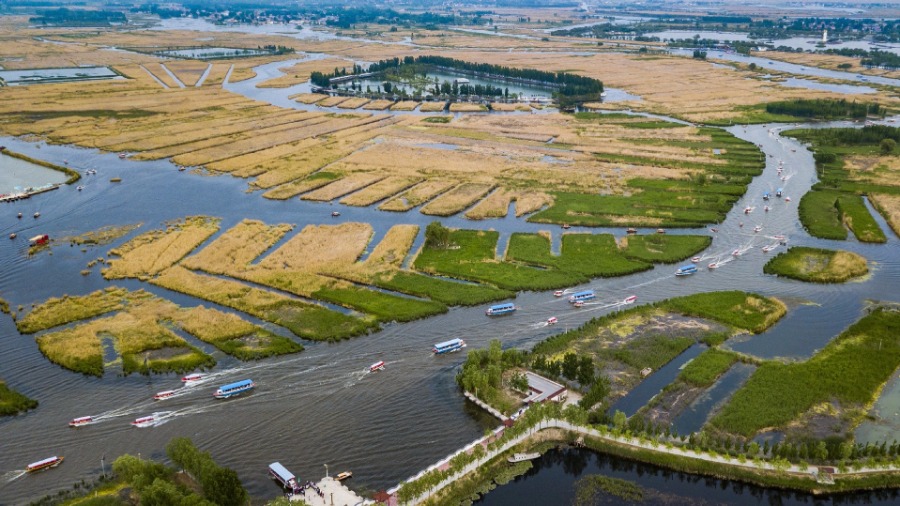
Baiyangdian Scenic Area, is a prominent natural landmark situated within the borders of Anxin county, Hebei province. Known for its picturesque landscapes and ecological significance, Baiyangdian is the largest freshwater lake on the North China Plain. The scenic area is a complex of 143 lakes of varying sizes, intricately carved by over 3,700 waterways. It is characterized by its vast coverage of reed marshes spanning 120,000 acres and lotus flowers covering 50,000 acres. The largest of these lakes is named Baiyangdian, giving the area its name. Approximately 30% of the area is land, while the remaining 70% is water. The lake system drains via Zhaolinzhuang into the Zhaowang River before flowing into the Haihe River and eventually discharging into the Bohai Sea near Tianjin. The region is renowned for its abundant fish, shrimp, reed mats, fresh lotus roots, and rice, earning it the historical moniker "Day-In, Gold-In" and the epithet "Pearl of North China."
History
The ecological and historical evolution of Baiyangdian is marked by significant geological and human activities. Its origins trace back to 602 BCE during the reign of King Ding of the Zhou Dynasty when the Yellow River breached its banks on the Hebei Plain and altered its course southwards. Consequently, Baiyangdian's water dynamics were transformed as tributaries derived from the Yellow River integrated into the lake system, continuously feeding it. Over time, these tributaries evolved into the nine rivers that sustain Baiyangdian's water supply today. Archaeological findings indicate human activity in the Dian area as far back as the Neolithic era, particularly in the western and southern parts, now known as Liucun and Liangzhuang in Anxin County. Historically, the region was an integral part of the ancient Yellow River's path, which flowed eastward along the Taihang Mountains alluvial fan to the sea, ensuring a stable water supply for the Baiyangdian area.
Attractions
Baiyangdian Scenic Area boasts a variety of attractions ranging from natural landscapes to cultural landmarks. Among the most notable is the Lotus Grand View Garden, which offers visitors an expansive view of the area's iconic lotus fields and a chance to experience the serene beauty of the surrounding wetlands. Mandarin Duck Island is another favorite spot, known for its picturesque scenery and diverse avian population, making it a haven for birdwatchers.
The Style Garden provides a blend of natural beauty and cultural enrichment, featuring traditional architecture and recreational activities that highlight the local cultural heritage. The Culture Park serves as an educational venue, offering insights into the region's history, local customs, and ecological significance. These attractions, coupled with the stunning natural environment of reeds, lotus flowers, and interconnected lakes, offer a rich tapestry of experiences for tourists and locals alike.
Ecology
Ecologically, Baiyangdian plays a pivotal role as a wetland ecosystem supporting a wide array of flora and fauna. As of 2022, the scenic area is home to 238 species of wild birds, reflecting a notable increase in biodiversity following the establishment of the Xiong'an New District. Among these species are several of significant conservation value, such as the Scaly-sided Merganser, Red-crowned Crane, and Great Bustard, which are protected under national conservation categories. Photo Gallery(4 pictures)CategoriesTourismTagNatural WonderCity TourismCatalogue1. Introduction2. History3. Attractions4. Ecology- - - []








